Case Studies [Exhibition / Culture] Casa Batlló, Spain
페이지 정보

작성자 MOPIC
작성일2026.03.06
작성일2026.03.06
본문
Case Study · Exhibition / Culture
Casa Batlló, Spain: Conveying Architectural Heritage with Glasses-Free 3D Displays
Architectural heritage, shown with its depth
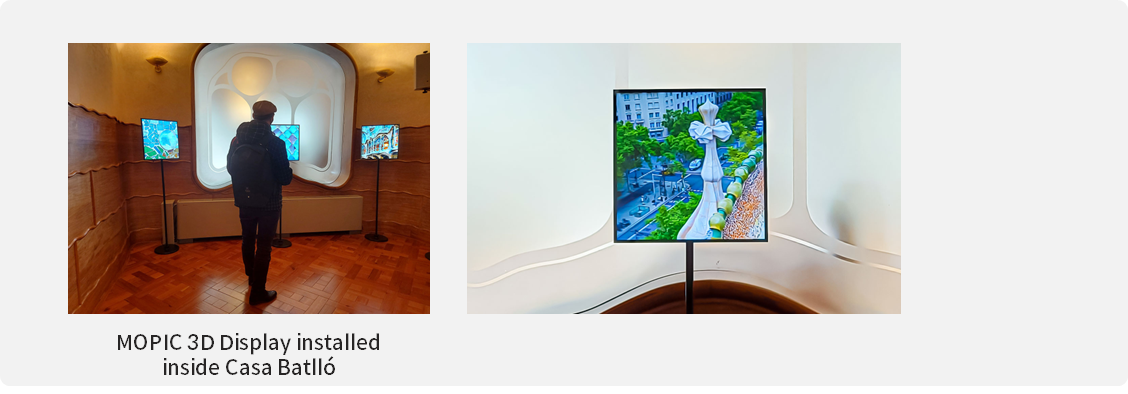
Casa Batlló created an exhibition in which visitors see the structure and restoration of Gaudí's architecture in 3D, as if looking into the real space. The museum's existing 2D images and video were converted to 3D content and run on 26.5-inch square glasses-free 3D displays with set-top boxes, designed for the exhibition space.
At a glance
| Customer | Casa Batlló (Spain) |
| Industry | Cultural exhibition / museum / heritage display |
| Viewing environment | Key zones of the exhibition — many visitors passing by and watching |
| Display | 26.5" glasses-free 3D display (square format, ultra-slim bezel, optics for the visitor route and average viewing distance) |
| Key technology | Depth optimized for the viewing distance · 2D image and video converted to 3D content |
| Integration | Content played from a dedicated set-top box — existing exhibition material converted and reused |
| Project stage | Installed in the exhibition space · permanent operation |
| Key results | Architectural structure and restoration visualized as glasses-free 3D content · visitors experience stereoscopic exhibits with no equipment · greater digital expressiveness and immersion in heritage exhibition |
1
Background and challenge
In an architectural-heritage exhibition, conveying the building's structure and sense of space effectively is essential. Exhibits on flat (2D) displays, however, were limited in expressing the depth and three-dimensional form of architecture. Museum visitors also increasingly expect more immersive digital exhibits. To meet this, Casa Batlló adopted MOPIC's new digital exhibition display solution, which draws visitors' attention easily and conveys architectural structure and artistic elements more intuitively.
Architecture is fundamentally an art of space; a flat photograph cannot convey how deep a curved ceiling is, or how walls and windows relate to each other. Restoration records are the same — which layer was added how is only legible with depth. When an exhibition display can show depth, the same material gains an entirely different persuasive power.
An exhibition is one of the most demanding viewing environments. Visitors stop as they pass, several at a time, each at a different distance. Glasses cannot be handed out, and no one can be instructed to wear them. Exhibition glasses-free 3D therefore has to be designed around the average viewing distance along the visitor route rather than one specific viewer, and the display itself has to look like part of the exhibition.
2
How it was applied
Casa Batlló introduced MOPIC's glasses-free 3D displays and exhibition content playback system in key zones of the exhibition space. MOPIC converts the museum's material to 3D, and displays and set-top boxes designed for the exhibition environment play it.
Existing assets — what the customer already had
The museum's 2D images and video of the architectural structure and restoration process, together with the visitor route and installation zones. Nothing was newly shot or produced; existing material was the starting point.
Added components — what MOPIC added
MOPIC supplied 26.5-inch glasses-free 3D displays designed for the visitor route and the average viewing distance, together with a dedicated set-top box for stable playback and operation of the exhibition content.
· Depth optimized for the viewing distance of the exhibition environment
· 3D visualization with depth that expresses architectural structure naturally
· A custom exhibition display design with a square format and ultra-slim bezel
Integration — how they were connected
MOPIC converted the museum's existing 2D images and video into 3D content for playback on the displays, creating a 3D exhibition content environment in which architectural structure, the restoration process and other information are expressed stereoscopically. The converted content plays from the dedicated set-top box, so the museum keeps the exhibition running without operating separate PCs or software.
How it fits together
Existing 2D images · video Architectural structure and restoration material | → | 2D → 3D content conversion MOPIC converts the exhibition material into stereoscopic content | → | 26.5" exhibition display + set-top box Square · ultra-slim bezel · optics for the exhibition distance · stable playback | → | Visitors Stereoscopic exhibits watched in passing, no glasses |
Customer-owned Provided by MOPIC
The square format and ultra-slim bezel are choices for the exhibition space. An ordinary 16:9 monitor looks like office equipment and easily spoils the exhibition design, and architectural material has many vertical elements that sit awkwardly on a wide screen. A square screen with a thin frame lets the display sit among the exhibits like a picture frame.
MOPIC took on the 2D→3D conversion so that the museum does not need 3D production staff. The museum hands over its material and concentrates on exhibition planning; the converted content ships in the set-top box and runs from installation. When the exhibition changes, only the content is replaced, the same way.
Watch the video
3
Results and value
| Item | Before | After (glasses-free 3D) |
|---|---|---|
| Conveying architectural structure | Flat images — depth and curved surfaces lost | Stereoscopic visualization, as if looking into the real space |
| Visitor equipment | — | None — watched in passing, many viewers at once |
| Content production | New 3D-native content required | Existing 2D material converted and reused |
| Operation | PC and software to run | Stable playback from a dedicated set-top box |
Heritage exhibited in three dimensions
Visitors understand architectural structure and details more intuitively through a sense of depth, as if looking into the real architectural space.
An immersive exhibition experience
Natural 3D viewing without special glasses lets visitors experience the exhibition content in a more comfortable setting.
Stronger digital exhibition capability
Extending existing flat content into 3D raised the museum's digital expressiveness and the utilization of its content.
Customer interview
“
When conveying architectural heritage through an exhibition, what matters most is how well the structure and depth of the space are expressed. With MOPIC's glasses-free 3D display, visitors feel as if they are looking into the real architectural space, and the exhibition communicates far more powerfully.
— from the Casa Batlló interview
Consider this approach if…
Not limited to architectural heritage. Any exhibition or space that wants to show its material to visitors in 3D can use the same configuration.
Where it applies
· Exhibition spaces where many people watch in passing — museums, galleries, corporate showrooms
· Exhibits whose content is about depth and structure — architecture, artifacts, products, processes
· You need to use existing 2D material without 3D production staff
· Spaces where the display is part of the design, so screen format and bezel matter
Terms used in this article
· 2D→3D content conversion — giving flat images and video depth information to create left- and right-eye images; offered by MOPIC as a production service
· Depth optimized for the viewing distance — lens design based on the average viewing distance along the visitor route, so depth holds for several viewers at once
· Set-top box — a dedicated playback unit that runs the converted 3D content on the display reliably
· Glasses-free 3D display — a display whose lens layer sends different images to the left and right eye, showing depth without glasses
Related case studies
[Exhibition / Promotion] Lotte Metaverse Exhibition Booth →
Same exhibition field — interactive content on 65" and 32" displays with the 3D SDK
[Telecom / Mobile Service] LG U+ and Global Telecom Operators →
Existing 2D content converted in real time and served in 3D
Related products
Learn more
Glasses-free 3D: essential background →
Lenses, viewing distance, viewpoint tracking — the basics of glasses-free 3D
Glasses-free 3D glossary →
Optical design · cameras · 3D content formats · software acronyms
Contact
If you are considering glasses-free 3D displays for a museum, showroom or other exhibition space, tell us the installation zones, the visitor route and your content formats (images, video, 3D). We will help you work out display size and format and the scope of content conversion.