Case Studies [Telecom / Mobile Service] LG U+ and Global Telecom Operators
페이지 정보

작성자 MOPIC
작성일2026.03.09
작성일2026.03.09
관련링크
-
관련링크
https://company.mopiclabs.net/hologlass/en
606회 연결
본문
Case Study · Telecom / Mobile service
LG U+ and a Global Telecom: A Smartphone-Based Glasses-Free 3D Platform Service
Glasses-free 3D on a smartphone alone
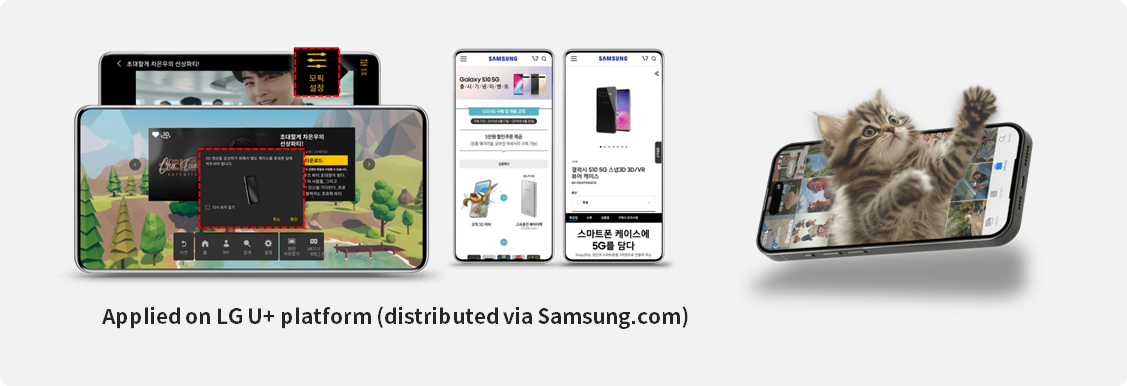
LG U+ and a global telecom launched a glasses-free 3D service anyone can use by attaching a screen-protector-style 3D lens to their phone. With HoloGlass and the iOS/Android 3D SDK, the operators added 3D video, 3D capture and real-time streaming to their existing apps and content platforms.
At a glance
| Customer | LG U+ (Korea), global telecom (Japan) |
| Industry | Telecom / mobile content services / platforms |
| Viewing environment | Users' own iPhones and Galaxy phones — personal viewing, anywhere |
| 3D lens | HoloGlass — a screen-protector-style 3D lens attached to the phone (9H tempered glass, 2D quality intact) |
| Key features | Real-time 2D→3D conversion · 3D capture with the phone camera · stereo and 3D VR playback · YouTube and other online video in 3D |
| Integration | iOS / Android 3D SDK — 3D features integrated directly into the customer's own platform and apps |
| Project stage | 3D content service in operation on the telecom platforms |
| Key results | A glasses-free 3D environment anyone can use by attaching glass to their phone · a range of mobile 3D services (3D video, 3D photo capture, live streaming) · new content services and higher user engagement on the platform |
1
Background and challenge
Existing VR and AR content services need separate equipment, which limits mainstream use. Telecoms and content platforms are therefore increasingly interested in a new mobile environment where 3D content can be watched anytime, anywhere, on a smartphone alone, and demand for glasses-free 3D that is easy to use on mobile is growing.
For an operator, the obstacle to a 3D content service was not content but devices. Headsets have low penetration and poor portability, which narrows the service audience, and a 3D-only smartphone would mean changing the whole handset lineup. A platform service only works if the iPhones and Galaxy phones already in users' hands can become 3D devices as they are.
The other condition is not to spoil the everyday 2D experience. If 3D degrades normal screen quality or means attaching and removing an accessory every time, users leave quickly. What was needed was something that stays on the phone as a screen protector and acts as a 3D lens only when 3D content plays.
2
How it was applied
LG U+ and a global telecom built a smartphone-based glasses-free 3D service environment with MOPIC's HoloGlass and 3D SDK, giving users a mobile 3D platform on which they can watch 3D video, photos and live content stereoscopically with nothing but their phone.
Existing assets — what the customer already had
The operators' own mobile apps and content platforms, and the iPhones and Galaxy phones users already own. No handset change, no new app ecosystem.
Added components — what MOPIC added
MOPIC provides HoloGlass, a 3D lens in the form of a screen protector that attaches to iPhone and Galaxy phones. Users turn their own phone into a glasses-free 3D device simply by attaching the glass.
· A screen-protector-style 3D lens that attaches easily to the phone
· 9H tempered glass for screen protection
· Original image quality preserved for everyday 2D content
Integration — how they were connected
MOPIC provides a 3D SDK for iOS and Android that lets customers integrate 3D features directly into their own platform or app. Real-time 2D→3D conversion, 3D capture with the phone camera, stereo and 3D VR video playback, 3D conversion and viewing of online video such as YouTube, and support for a wide range of phone models with room for new devices are all included in the SDK, so the operator can focus on content and service planning.
How it fits together
Own app · content platform The operator's mobile service and content | → | iOS / Android 3D SDK 3D playback, 2D→3D conversion and 3D capture integrated into the app | → | HoloGlass Attachable 3D lens for the phone — doubles as a screen protector | → | User's smartphone 3D on an iPhone or Galaxy, no glasses |
Customer-owned Provided by MOPIC
HoloGlass is a lens, not a display. The lens layer on the phone screen splits the screen's pixels between the left and right eye, and the SDK calculates which pixels go to which eye according to each device model's screen specification. So the list of devices the SDK supports is the service's reach, and new devices are added through SDK updates.
Real-time 2D→3D conversion is especially meaningful for an operator. Serving only content produced in 3D makes for a small library; being able to convert existing 2D video and online video such as YouTube means there is plenty to watch from day one. Add 3D photo and video capture with the phone camera, and a viewing service becomes a creating service.
Watch the video
3
Results and value
| Item | Before | After (glasses-free 3D) |
|---|---|---|
| 3D viewing device | Separate VR/AR equipment required | The user's iPhone or Galaxy + an attachable lens |
| Everyday 2D use | — | Works as a screen protector, quality intact — no attaching and removing |
| Service content | Limited to content produced in 3D | Existing 2D and online video converted in real time + 3D capture + stereo/3D VR |
| Platform integration | Separate app and device ecosystem | SDK integrated into the operator's own app — service inside the existing platform |
A smartphone-based 3D service
Users enjoy 3D content on their smartphone alone, with no extra equipment, making the 3D service far more accessible.
Higher platform engagement
Introducing 3D video and content services strengthened user engagement and the content consumption experience on the platform.
Room for new content and services
The 3D content service provides a foundation for expansion into subscription content, premium video services and a range of 3D content businesses.
Customer interview
“
One of the most important things in a mobile content service is giving users a new experience. With MOPIC's HoloGlass and 3D SDK we launched a 3D content service enjoyed on a smartphone alone, taking our platform's content competitiveness a step further.
— from the customer interview
Consider this approach if…
You do not have to be a telecom. Any content, commerce or education service that runs on users' own smartphones can apply the same structure.
Where it applies
· Platform operators who already have their own app and user base and want to offer a new experience inside it
· Mass-market services that cannot ask users to buy a separate device — OTT, commerce, education, fan content
· Services with little 3D-native content that need to convert existing 2D video
· Participatory services where users capture and share their own 3D photos and video
Terms used in this article
· HoloGlass — a 3D lens in the form of a smartphone screen protector; attach it for glasses-free 3D, with 2D quality unchanged
· iOS / Android 3D SDK — MOPIC's developer kit that adds 3D playback, conversion and capture to a customer's app, calculating 3D output for each device model's screen
· Real-time 2D→3D conversion — estimating depth in a flat video and generating left- and right-eye images to show it in 3D
· Stereo · 3D VR video — 3D video formats with separately captured left- and right-eye images; 3D VR is captured with a wide field of view (VR180, VR360)
Related case studies
[Video Conference] Major U.S. IT Company →
Same telecom field — a display for 3D video communication co-developed with the customer
[Exhibition / Promotion] Lotte Metaverse Exhibition Booth →
The same pattern in exhibitions — existing content made glasses-free 3D with the 3D SDK
Related products
Learn more
Glasses-free 3D: essential background →
Lenses, viewing distance, viewpoint tracking — the basics of glasses-free 3D
Glasses-free 3D glossary →
Optical design · cameras · 3D content formats · software acronyms
Contact
If you are considering a smartphone-based 3D service for a mobile app or content platform, tell us the type of service (video, commerce, education), the main devices you support and your content formats. We will help you work out HoloGlass supply and the scope of SDK integration.