Case Studies [Exhibition / Promotion] Lotte Metaverse Exhibition Booth
페이지 정보

작성자 MOPIC
작성일2026.03.06
작성일2026.03.06
본문
Case Study · Exhibition / Promotion
Lotte Metaverse Exhibition Booth: Immersive Content on Glasses-Free 3D Displays
A metaverse booth visitors experience with no gear
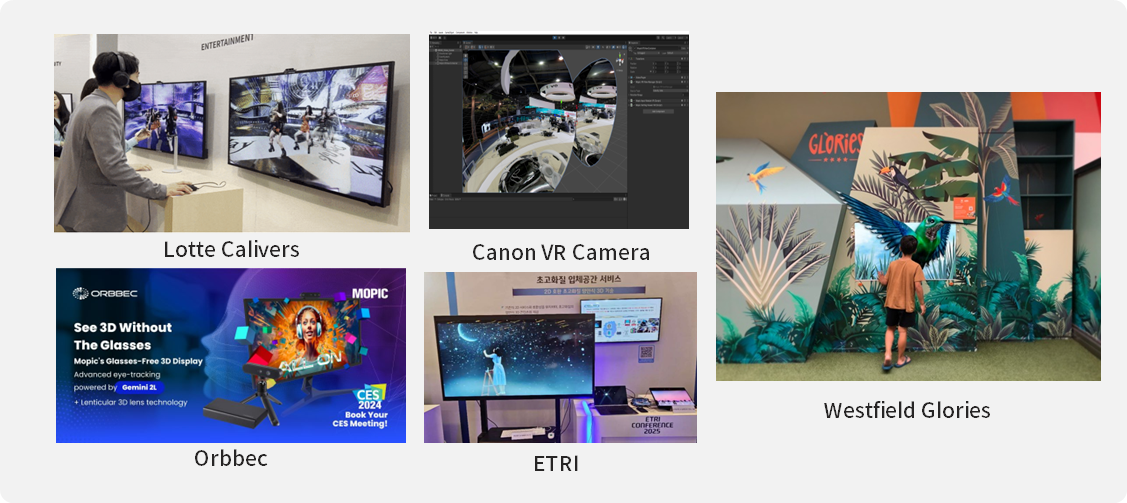
Lotte Caliverse ran a metaverse booth that visitors could experience as they walked past, with no headset. Its existing metaverse content was made into glasses-free 3D interactive content with the MOPIC 3D SDK, and 65-inch and 32-inch displays placed along the booth's visitor flow drew the crowds.
At a glance
| Customer | Lotte Caliverse (Korea) |
| Industry | Exhibitions / brand promotion / IT and consumer electronics events / metaverse content |
| Viewing environment | Main experience zone of a brand booth at a large exhibition — many visitors at once |
| Display | 65" and 32" glasses-free 3D displays (placed for the booth's visitor flow and viewing distance) |
| Key technology | Stereoscopic visualization of metaverse content · real-time interaction with 3D objects |
| Integration | MOPIC 3D SDK — existing metaverse content made into glasses-free 3D interactive content |
| Project stage | Booth operation at an exhibition (alongside the existing VR zone) |
| Key results | Metaverse 3D content with interaction delivered in glasses-free 3D · an immersive experience available instantly with no equipment · longer dwell time and higher visitor engagement |
1
Background and challenge
At a large exhibition, visual differentiation that catches visitors' eyes quickly among the many brand booths is essential. 2D displays alone, however, struggled to convey the spatial feel of metaverse content and 3D graphics, and VR content, which requires an HMD, often failed to turn into an actual experience because of the hassle of putting one on.
At an exhibition booth the bottleneck is equipment. An HMD serves one person at a time, takes time to fit and keep hygienic, and the moment a queue forms, many visitors walk away. An experience that only requires looking at a screen in passing lets many people take part at once with no waiting, and a crowd in front of the booth is itself promotion.
It also matters that metaverse content is already 3D. Spaces, characters and objects are all 3D data, so if the display can show depth, no new content has to be made. That is why Lotte Caliverse ran a glasses-free 3D zone next to its existing VR zone.
2
How it was applied
Lotte Caliverse applied MOPIC's glasses-free 3D displays and 3D SDK in the main experience zone of its booth to deliver immersive metaverse content. The existing metaverse content stayed as it was; only the output became glasses-free 3D.
Existing assets — what the customer already had
Lotte Caliverse's metaverse content — 3D spaces, characters, objects and interaction logic. The content assets and production environment stay unchanged.
Added components — what MOPIC added
MOPIC installed 65-inch and 32-inch glasses-free 3D displays placed for the booth's visitor flow and viewing distance: the large screen catches the eye of visitors passing the booth, and the 32-inch serves visitors who come closer to interact.
Integration — how they were connected
Lotte Caliverse used the MOPIC 3D SDK to deliver its existing metaverse content in glasses-free 3D. With real-time interaction with 3D objects and stereoscopic visualization of the metaverse content, the booth offered a hands-on content environment that raised visitor engagement. Because the content team only changes the output through the SDK, the booth can be prepared quickly for the event schedule.
How it fits together
Metaverse 3D content 3D spaces · characters · objects and interaction logic | → | MOPIC 3D SDK Content output as glasses-free 3D · real-time interaction preserved | → | 65"·32" glasses-free 3D displays Placed for the booth's visitor flow and viewing distance | → | Visitors Experienced in passing, no HMD |
Customer-owned Provided by MOPIC
Because an exhibition display is watched by several people from different positions, depth is designed around the average viewing distance in front of the booth rather than tracking one viewer. The large 65-inch screen is the first thing visitors see as they walk up; the 32-inch is where they come close and interact — separating the stage that attracts attention from the stage that invites participation.
Running the VR zone and the glasses-free 3D zone side by side serves different visitors. Those who want to spend time on a deep experience go to VR; those who stop by briefly go to glasses-free 3D — increasing the number of people the booth as a whole can reach.
Watch the video
3
Results and value
| Item | Before | After (glasses-free 3D) |
|---|---|---|
| Experience | HMD worn — one at a time, queues | Experienced in passing — many at once |
| Content delivery | 2D screens lack the spatial feel of the metaverse | Content that appears to leap out of the screen + real-time interaction |
| Content production | — | Existing metaverse content used as is through the 3D SDK |
| Booth outcome | Many visitors never reach the experience | Longer dwell time, higher engagement, a natural crowd in front of the booth |
Visitors' attention captured
Visitors experienced products and content appearing to leap out of the screen, with no equipment at all.
A more participatory exhibition
An intuitive 3D experience increased visitors' dwell time and booth engagement.
A stronger brand experience
An exhibition staged with glasses-free 3D conveyed Lotte's metaverse content and brand image effectively.
Customer interview
“
For this exhibition we ran MOPIC's glasses-free 3D display alongside our existing VR zone to raise visitor immersion. Visitors could experience stereoscopic content instantly without wearing anything, so more people naturally gathered in front of the booth. Watching the reactions on site confirmed that the glasses-free 3D display greatly enhanced the exhibition experience.
— from the Lotte Caliverse interview
Consider this approach if…
It does not have to be a metaverse. The same configuration works for any brand with 3D content at an exhibition or promotion.
Where it applies
· Brands with content already produced in 3D — games, metaverse, 3D product models
· Events that must draw many visitors in a short time — trade shows, pop-up stores, showrooms
· Cases where the waiting, hygiene and one-at-a-time limits of HMD experiences are a burden
· Plans for interactive experiences where visitors operate and respond to the content
Terms used in this article
· MOPIC 3D SDK — a developer kit that renders 3D content (Unity and others) from left and right viewpoints for a glasses-free 3D display, keeping real-time interaction
· HMD (head-mounted display) — a VR headset worn on the head; highly immersive but single-user, with fitting and waiting overhead
· Interactive content — content that responds in real time to what the visitor does
· Glasses-free 3D display — a display whose lens layer sends different images to the left and right eye, showing depth without glasses
Related case studies
[Exhibition / Culture] Casa Batlló, Spain →
Same exhibition field — existing 2D material converted to 3D for a permanent exhibition
[Automotive / Infotainment] Mobase →
The same pattern — existing 3D assets output as glasses-free 3D with the Unity 3D SDK
Related products
Learn more
Glasses-free 3D: essential background →
Lenses, viewing distance, viewpoint tracking — the basics of glasses-free 3D
Glasses-free 3D glossary →
Optical design · cameras · 3D content formats · software acronyms
Contact
If you are considering a glasses-free 3D experience booth for a trade show, pop-up or showroom, tell us the event schedule, the booth size and your content formats (Unity or other 3D content, video). We will help you work out display configuration, 3D SDK integration and operation.