Case Studies [Automotive / HMI] Renault
페이지 정보

작성자 MOPIC
작성일2026.03.09
작성일2026.03.09
본문
Case Study · Automotive / HMI
Renault: Developing a Glasses-Free 3D Rear-View System
A rear-view display that shows real depth
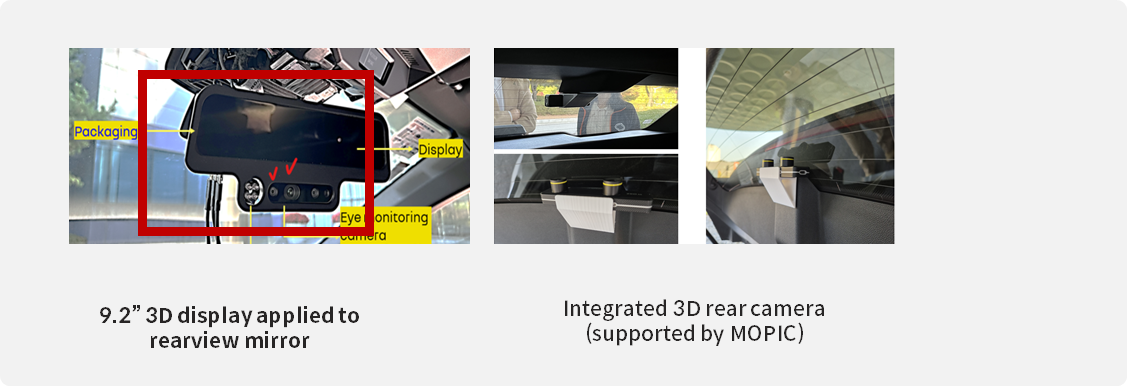
Together with MOPIC, Renault developed a 9.2-inch rear-view display that shows the rear camera feed in 3D, with no glasses. The prototype lets drivers judge the distance and space behind the car by eye, and the project validated that in-vehicle 3D displays can be manufactured at scale.
At a glance
| Customer | Renault (France) |
| Industry | Automotive / in-vehicle displays / driver assistance systems |
| Viewing environment | Driver's seat — a single viewer in a fixed position |
| Display | 9.2" in-vehicle glasses-free 3D display module (optics designed for the driver's seating position) |
| Key technology | Eye-tracking-based 3D rendering · ultra-low-latency real-time 3D conversion |
| Integration | Native 3D SDK — 3D added without major changes to the existing rear-camera system |
| Project stage | Rear-view mirror prototype and feasibility validation |
| Key results | Rear camera feed shown in glasses-free 3D in real time · better driver distance perception · applicability of in-vehicle 3D display technology validated |
1
Background and challenge
Conventional rear and side mirror systems are based on flat images, so drivers can find it hard to judge distance and spatial relationships. Precise distance perception matters most when parking and reversing. As a result, interest in 3D-based vehicle vision systems is growing across the automotive industry.
The reason depth disappears in a flat image is simple. We perceive distance from the small differences between what our two eyes see (binocular disparity), and an ordinary camera image is a single picture from a single viewpoint, so that difference is gone. Drivers end up estimating distance from indirect cues such as the size of nearby objects or guide lines on the ground, and the fewer the cues — tight parking spaces, night driving — the shakier the judgment.
Solving this with 3D comes with one more condition: you cannot put 3D glasses or a headset on a driver. 3D inside a vehicle has to be glasses-free, and it has to hold a stable stereoscopic image from one fixed position, the driver's seat. That is the rear-view system Renault set out to validate with MOPIC.
2
How it was applied
Renault installed a 3D camera in the vehicle's rear-camera system and applied MOPIC's glasses-free 3D display module and 3D image processing to build a rear-view mirror prototype that shows the rear camera feed in 3D in real time. From the customer's point of view, the deployment breaks down into three parts: what they already had, what MOPIC added, and how the two were connected.
Existing assets — what the customer already had
The vehicle's rear-camera system and the rear-view pipeline that shows its image to the driver. A 3D camera was added to capture left and right viewpoints. The skeleton of the existing imaging system stays as it is.
Added components — what MOPIC added
MOPIC developed a 9.2-inch in-vehicle glasses-free 3D display for the vehicle environment: optics designed around the driver's fixed seating position, and eye-tracking-based 3D rendering that aligns the stereoscopic image to the driver's eye position.
· 3D optical design based on the occupant's seating position
· Eye-tracking-based 3D rendering aligned to the driver's viewpoint
· Real-time 3D display linked to the 3D rear-camera input
Integration — how they were connected
MOPIC's Native 3D SDK made it possible to add 3D to the existing rear-camera system without major structural changes. The rear camera feed is converted and displayed in 3D in real time with ultra-low latency. When reversing, a picture that lags behind reality is a hazard, so latency is as important a condition as image quality for a rear-view application.
How it fits together
3D rear camera Rear image from left and right viewpoints | → | 3D image processing Native 3D SDK · ultra-low-latency real-time 3D conversion | → | 9.2" glasses-free 3D display Optics for the driver's seat · eye-tracking aligns to the driver's viewpoint | → | Driver Rear view with real depth, no glasses |
Customer-owned Provided by MOPIC
Eye-tracking is there because of the environment. Unlike an exhibition display watched by many people from many positions, a rear view is watched by one driver from one seat. A camera tracks the driver's eye position and aligns the stereoscopic image to it, so the 3D effect stays sharp even when the head moves.
3
Results and value
| Item | Before | After (glasses-free 3D) |
|---|---|---|
| Rear distance perception | Estimated from indirect cues (object size, guide lines) | Space and distance behind the car perceived directly from the 3D image |
| Driver equipment | — | None — glasses-free |
| Scope of system change | — | Native 3D SDK keeps the existing rear-camera system structure |
| Extensibility | Rear camera only | Structure applicable to side-view and front-camera systems |
Better rear-view perception
With the rear view shown in 3D, drivers perceive the space and distance relationships behind the vehicle more intuitively.
Extensible to other vehicle camera systems
The 3D display technology was developed in a structure that applies not only to the rear camera but also to side-view and front-camera systems. Because the conversion stage between camera input and display is the same, moving a validated pipeline to another camera system carries little overhead.
Stronger premium-vehicle technology
By validating the manufacturability and applicability of in-vehicle 3D displays, the project laid a foundation the customer can use in developing next-generation vehicle interfaces.
Customer interview
“
One of the most important elements of a vehicle safety system is how accurately the driver can perceive the surroundings. MOPIC's glasses-free 3D display technology let us confirm a new visual experience in which drivers judge distance and space far more intuitively.
— from the Renault interview
Consider this approach if…
This pattern is not limited to Renault's rear view. If two or more of the conditions below apply, the same structure carries over as it is.
Where it applies
· A system that shows camera images to a person who must judge distance or space (rear, side or front cameras; vision aids for work vehicles and heavy machinery)
· A single-viewer environment where the viewer and their position are fixed, such as a driver's or operator's seat — the best condition for eye-tracking
· An imaging pipeline already in operation, where 3D has to be added without major structural changes
· Real-time use where latency is a precondition for adoption
Terms used in this article
· Glasses-free 3D display — a display whose lens layer sends different images to the left and right eye, showing depth without glasses
· Eye-tracking — a camera tracks the viewer's eye position and aligns the stereoscopic image to it; suited to single-viewer, fixed-position environments
· Native 3D SDK — MOPIC's developer kit that adds 3D display capability without changing the existing software structure
· Ultra-low latency — processing that minimizes the delay from camera input to 3D display; the key condition for real-time applications such as a rear view
Related case studies
[Automotive / Infotainment] Mobase →
Same vehicle environment — an 8.9" display and the Unity 3D SDK add depth to an existing UI
[Industrial / Microscope] Solectrix →
Fixed viewing position + Native 3D SDK — the same pattern applied to industrial equipment
Related products
Learn more
Glasses-free 3D: essential background →
Lenses, viewing distance, viewpoint tracking — the basics of glasses-free 3D
Glasses-free 3D glossary →
Optical design · cameras · 3D content formats · software acronyms
Contact
If you are considering glasses-free 3D for an in-vehicle display or a camera-based vision system, tell us about the environment (viewing position and distance, camera configuration, existing imaging system). We will help you work out the right display size and SDK configuration.