Case Studies [Medical / Education] Seoul National University Hospital Smart Simulation Center
페이지 정보

작성자 MOPIC
작성일2026.03.06
작성일2026.03.06
본문
Case Study · Medical / Education
Seoul National University Hospital: Real-Time 3D Endoscopic Video Streaming for Surgical Training
3D endoscope video, live outside the operating room
Seoul National University Hospital built an environment in which the operating room's 3D endoscope feed can be watched on training-room monitors with exactly the same depth, and no glasses. A 32-inch glasses-free 3D display and GPU-based ultra-low-latency streaming deliver the surgeon's sense of space and depth to trainees as it is.
At a glance
| Customer | Seoul National University Hospital — Smart Simulation Center (Korea) |
| Industry | Medical / surgical training / hospital |
| Viewing environment | Training room outside the OR — each trainee at their own monitor |
| Display | 32" custom glasses-free 3D display (depth optimized for the training-room viewing distance) |
| Key technology | Real-time playback of SBS 3D endoscope video · GPU-based ultra-low-latency 3D video streaming |
| Integration | The existing 3D endoscope's SBS output is taken as is and converted to glasses-free 3D — no change to endoscope equipment |
| Project stage | Deployed and in operation at the surgical simulation center |
| Key results | 3D endoscopic surgery video transmitted in real time · the same stereoscopic view watched outside the OR without 3D glasses · greater usability and accessibility of medical-education infrastructure |
1
Background and challenge
As 3D endoscopic surgery becomes more common, surgical training increasingly needs an environment that conveys the same sense of space and depth the surgeon sees. Many existing 3D training setups, however, require special 3D glasses, which makes them inconvenient to use. 3D display equipment suited to medical education is also expensive and in limited supply, so it has often been hard to bring into real training environments.
In 3D endoscopic surgery the surgeon reads tissue depth from the two images a stereo camera sends, and moves instruments accordingly. Send that video to a training room on a flat monitor and the depth is gone: trainees cannot tell from the image alone why the surgeon approached at that angle. 3D glasses solve this, but in a training room where many people watch for long periods, managing glasses and the fatigue of wearing them become another burden.
A training environment has one more requirement: it has to support several units, not one. Dedicated medical 3D equipment is costly, so it tends to stop at one or two units, and utilization per trainee stays low. That is why Seoul National University Hospital looked at a monitor-based glasses-free 3D system.
2
How it was applied
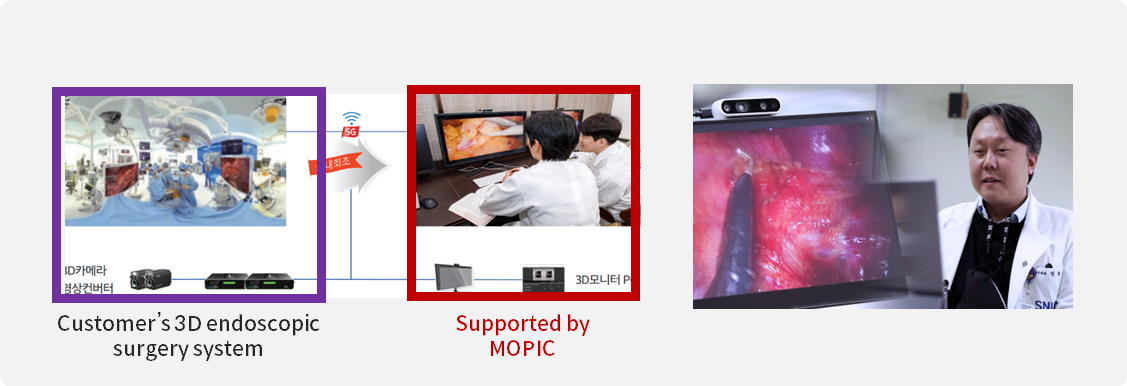
Seoul National University Hospital introduced MOPIC's glasses-free 3D display system and real-time 3D video playback software at its surgical simulation center. The existing 3D endoscope stays as it is; MOPIC's components sit on the path its output video takes to the training-room monitors.
Existing assets — what the customer already had
The 3D endoscope system operating in the OR, the side-by-side (SBS) 3D video it outputs, and surgical training materials produced in 3D. Neither the endoscope equipment nor the video format changes.
Added components — what MOPIC added
MOPIC supplied a 32-inch custom glasses-free 3D display for the surgical training environment, with depth optimized for the distance at which each trainee views their own monitor, and precise display alignment for a clean stereoscopic image without ghosting.
· Depth optimized for the training-room viewing distance
· Precise display alignment for a clean stereoscopic image without ghosting
Integration — how they were connected
Software that plays the side-by-side (SBS) video output by the existing 3D endoscope system in glasses-free 3D in real time was applied, so that both the 3D endoscope video captured during surgery and training materials produced in 3D play stereoscopically on the monitor. To carry the OR's 3D endoscope video to an external training room, MOPIC supplied a GPU-based ultra-low-latency 3D video streaming solution, creating a training environment in which the surgeon's 3D view can be followed in real time outside the operating room.
How it fits together
OR 3D endoscope Side-by-side (SBS) 3D video output | → | GPU ultra-low-latency streaming OR → training room, 3D video in real time | → | 32" glasses-free 3D display SBS played as glasses-free 3D in real time · optics for the training-room distance | → | Trainees Each at their own monitor, the surgeon's stereoscopic view, no glasses |
Customer-owned Provided by MOPIC
SBS is a 3D video format that places the left- and right-eye images side by side in one frame; most 3D endoscopes and 3D cameras output it. Because MOPIC's playback software takes this format as is and turns it into glasses-free 3D, the hospital never touches endoscope equipment or video settings. For the same reason, training materials produced in SBS play on the same monitors with no conversion.
Low streaming latency matters because training happens live. If the training-room picture visibly lags the OR, the surgeon's commentary and the image drift apart, and teaching that follows the flow of surgery with live questions becomes difficult. GPU-based processing keeps that delay to a minimum so the OR and the training room see the same moment.
Watch the video
3
Results and value
| Item | Before | After (glasses-free 3D) |
|---|---|---|
| What trainees see | Flat monitor — no depth | The surgeon's stereoscopic view, shared in real time |
| Viewing equipment | 3D glasses (management, wearer fatigue) | Monitor only, no glasses |
| Equipment | Costly dedicated medical 3D units — few installed | Monitor-based system — several units in the training room |
| Training materials | 3D playback only on dedicated equipment | SBS materials play stereoscopically on the same monitors |
Better understanding in surgical training
Trainees understand anatomical structures and surgical procedures more intuitively in a stereoscopic environment close to real surgery.
A cost-effective 3D training environment
By using a monitor-based glasses-free 3D system instead of dedicated 3D equipment, the hospital can install several displays in the training environment, building a cost-effective 3D training setup.
An expanded digital medical-education environment
Introducing a glasses-free 3D surgical training system has further strengthened the hospital's digital medical-education environment.
Customer interview
“
What matters most in surgical training is conveying exactly the sense of space and depth the surgeon sees. With MOPIC's glasses-free 3D display we can share the same stereoscopic view outside the operating room, and the training environment has become far more useful.
— from the Seoul National University Hospital interview
Consider this approach if…
Beyond surgical training, the same structure applies wherever the output of 3D imaging equipment has to be shown to several people.
Where it applies
· You already have equipment that outputs SBS-format video — a 3D endoscope, 3D laparoscope or 3D camera
· That video has to be watched outside the room where the equipment is (training room, conference room, remote site)
· Many people watch for long periods, so 3D glasses are a burden
· Training or education facilities that need several units installed economically rather than dedicated 3D equipment
Terms used in this article
· SBS (side-by-side) — a 3D video format with the left- and right-eye images next to each other in one frame; the usual output of 3D endoscopes and 3D cameras
· Glasses-free 3D display — a display whose lens layer sends different images to the left and right eye, showing depth without glasses
· Ultra-low-latency 3D streaming — GPU-based processing and transmission of 3D video that minimizes the delay between sending and viewing
· Precise display alignment — matching lens and panel positions precisely to reduce ghosting (crosstalk), where the left and right images overlap
Related case studies
[Medical / Microscope] Seoul National University Hospital Smart Simulation Center →
Another application at the same hospital — inspection microscope images viewed in 3D without eyepieces, on a Dhaula 15.6″
[Medical / Image Analysis] EchoPixel →
Same medical field — CT and MRI data analyzed in 3D on 65" and 32" displays with the Native 3D SDK
[Automotive / HMI] Renault →
Camera video converted to 3D in real time with ultra-low latency — the same real-time requirement in a vehicle
Related products
Learn more
Glasses-free 3D: essential background →
Lenses, viewing distance, viewpoint tracking — the basics of glasses-free 3D
Glasses-free 3D glossary →
Optical design · cameras · 3D content formats · software acronyms
Contact
If you are considering glasses-free 3D for a medical training or simulation center, or for sharing video from 3D imaging equipment, tell us the equipment's output format and the viewing environment (number of viewers, distance, transmission path). We will help you work out the right display size and the playback and streaming configuration.